
Carlsbad Previous Residents by Era
For previous residents of a Carlsbad address, begin with the source that matches the period. The Eddy County Clerk’s records make an ownership chronology possible, while library directories and census schedules provide household evidence at particular dates. Maps describe the physical place. Each source has a boundary: a recording is not a move-in date, a directory is not a complete household roll, and a map does not identify an occupant.
| Source | Years it covers | Where held | What it shows |
|---|---|---|---|
| Historic Clerk index books | 1884–1979 listed series | Eddy County Clerk portal and counter | Party, book, page, and recorded-interest leads |
| Carlsbad city directories | 1939–2026 holdings | Carlsbad Public Library | Dated person-to-address and street-directory entries |
| Federal population census | Public through 1950 | NARA-authorized access channels | Household snapshot on the census date |
| Carlsbad Sanborn maps | 1900, 1905, 1909, 1913, 1921, 1930, 1943, 1950 | Library of Congress | Street and building context |
| Permits and inspections | Historic retention not published | City Building or a focused IPRA request | Property activity and timing leads |
The Clerk does not publish an online start year or uninterrupted image coverage for real-property records. Ask for the earliest searchable and retrievable year for the document type that matters, and ask whether a copy or certification is available. The library’s 1939–2026 collection is likewise incomplete before 1939 and for 1943 through 1945.
Inspect the 1948 Carlsbad and Happy Valley directory scan as a dated household source.
The 1948 scan is an example of a usable historic source, not a complete run for every year or address.
Carlsbad Address Ownership Start
Build a recorded ownership chain before calling it a resident history. The current Eddy Assessor property account supplies a parcel and tax context, and the legal description is the durable handoff to the Clerk’s recorded-document search. A street name by itself can be weak across subdivisions, similar numbering, or changed address formatting. Preserve the lot, block, subdivision, tract, or other legal-description details alongside the physical address.
The Assessor’s local card separates a situs address, which is where property sits, from an owner mailing address, which is where a tax bill is sent. The mailing address can be a useful lead, but it may belong to a post-office box, trustee, agent, or another property. Neither field establishes every person who lived at the address. Use the current account only as the first bridge toward a dated deed or plat.
Check the Carlsbad Public Library’s documented directory holding details.
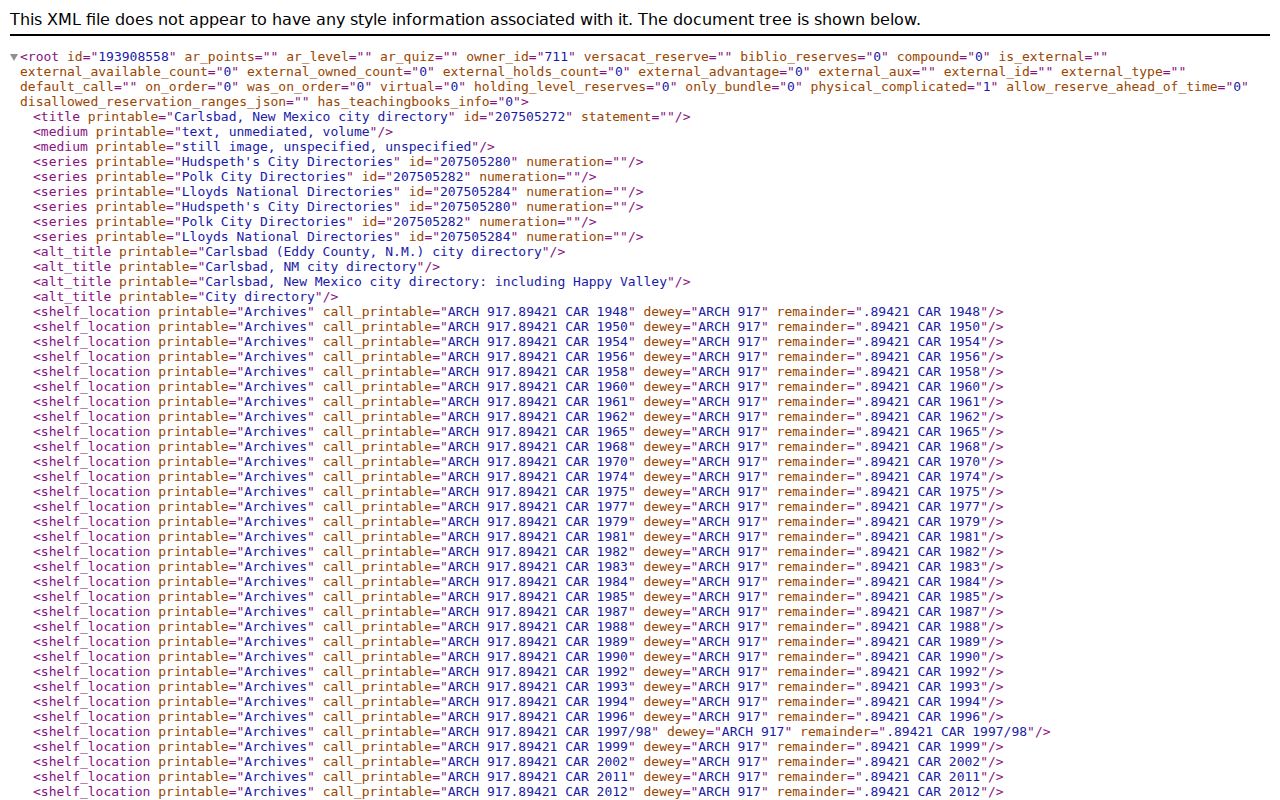
The catalog image shows why historical-address work should record the exact edition that was checked.
Trace Carlsbad Previous Owners by Deed
The Eddy County Official Records Advanced Search is keyed to party names, grantor, grantee, recorded date, book, page, document number, document-image text, and legal description. It does not promise a literal street-address search. Use the current owner, legal description, subdivision, lot, block, and a likely recorded date to locate a candidate instrument, then examine the record details instead of relying on a same-name match.
- Get the current parcel account and legal description from EagleWeb or the map context, keeping the situs and mailing addresses separate.
- Search the current owner as a grantee or party, with the legal description or lot and block details where available.
- Open the candidate conveyance and record its instrument number, recorded date, book, page, grantor, grantee, and legal description.
- Use the prior grantor as the next grantee lead, then repeat while checking that the legal description still matches.
- When online continuity or image access is unclear, ask the Clerk for the underlying index book, copy, or certified-copy route.
- Grantor and grantee
- The grantor transfers an interest in a recorded instrument. The grantee receives that recorded interest.
- Chain of title
- A sequence of recorded transfers for a particular parcel or interest. It is not a complete list of everyone who lived there.
- Legal description
- The formal lot, block, subdivision, tract, or survey wording that ties a property account to deeds and plats more reliably than a street label.
View the Clerk’s advanced-search interface before entering a party or legal-description query.
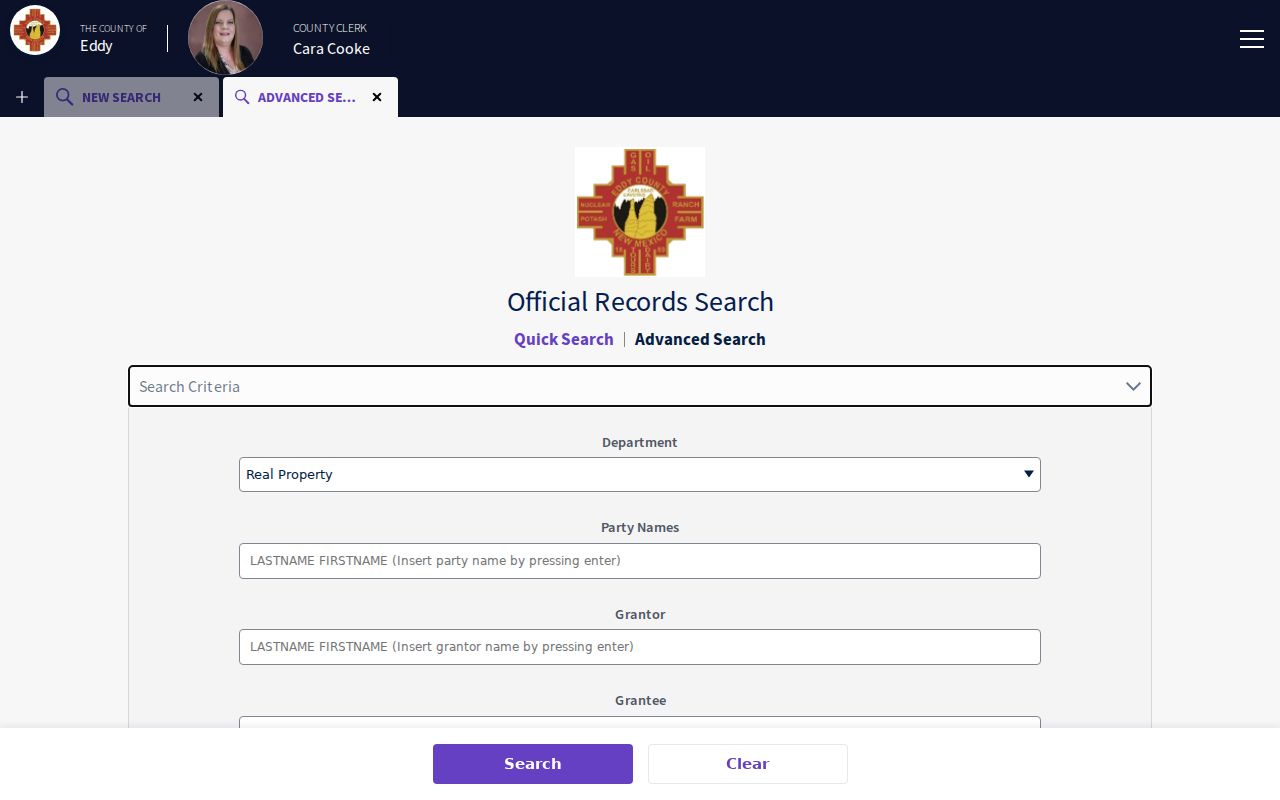
The search image illustrates the party and legal-description route used for a recorded ownership trail.
| Instrument number | Identifies the recorded real-property result for follow-up with the Clerk. |
|---|---|
| Recorded date and pages | Dates the recording and shows the result’s reported page count. |
| Book and page | Provides a legacy reference when those fields appear in the result. |
| Grantor and grantee | Names the recorded parties used to walk an ownership sequence backward. |
| Legal-description data | Tests whether the instrument concerns the same parcel or recorded interest. |
The result is an index lead. The underlying document remains the record to check when a name, parcel, or transfer matters.
Note: Recording date can date the instrument, but it is not necessarily the sale closing date or a household move date.
Carlsbad Previous Residents and Index Books
Early Carlsbad work has a concrete recorded-index bridge. The Clerk portal lists General Index books for 1884–92, 1892–1903, 1902–05, 1905–06, 1906–08, 1908–09, 1909–10, and 1910–12. Listed grantor and grantee blocks continue from 1912 through 1979, with separate blocks such as 1912–17, 1936–48, 1948–53, 1953–63, 1963–72, and 1973–79.
Those years document index-book series, not a promise that every deed image is online. Capture the book, page, party, and legal-description lead. Then ask the Clerk at 325 S. Main Street or call 575-885-3383 about the underlying record, image, or certified-copy route. The same office is recorder, probate clerk, marriage-license issuer, and chief election official, but those functions have different records and access limits.
Carlsbad Previous Residents on Sanborn Maps
Sanborn fire-insurance maps add building context to a Carlsbad address trail. The Library of Congress identifies Carlsbad editions for 1900, 1905, 1909, 1913, 1921, 1930, 1943, and 1950. A sheet can show a building footprint, materials, street names and numbers, nearby structures, and sometimes additions. Pair the selected sheet with a legal description, a recorded deed, a permit date, and a local directory entry.
A Sanborn sheet is not a people directory. It can help decide whether the same structure or street configuration is being followed across a change, but it cannot show who lived there. For a current address-format question, City Planning advises using directional prefixes without a period, such as S Halagueno, and spelling numbered streets, such as Eighth St.
Past Carlsbad Households Through 1950
Past residents need a household layer alongside the ownership chain. The library catalog describes Carlsbad directories with alphabetical and street-directory components, and the 1948 Hudspeth volume includes Happy Valley. A directory can tie a printed name to an address in an inter-census year. The federal census, publicly released through 1950, adds a dated household snapshot. Neither source is complete by itself, and a person missing from one does not prove a move or death.
- Start with a directory edition that gives a name or address, and record its title, publisher, year, and page.
- Use the closest census year to compare the household, age, birthplace, and other recorded details for that date.
- Return to the next available directory year to test whether the address or name form changed.
- Use a street-directory entry, obituary, cemetery inquiry, or probate file only as a dated follow-up lead.
The Carlsbad city directory collections explain how to inspect an entry and distinguish publisher-specific marks before drawing a conclusion from one listing.
Contact the library’s local-history service for a specific Carlsbad directory volume.
The library is the local access route when a printed directory, yearbook, map, or obituary file must be checked by date.
Carlsbad Previous Residents Also Search Eddy
Carlsbad was renamed from Eddy in 1899, so a past-resident search should use both names. This is especially important for early directories, newspapers, maps, and recorded-index work. The local newspaper trail includes the Eddy Current through May 27, 1899 and the Carlsbad Current beginning June 3, 1899. Try both city terms, preserve the literal source spelling, and add Happy Valley where the 1948 directory title makes it relevant.
The former name is a local index clue rather than proof of identity. Compare a full name, address, legal description, date, spouse notation where printed, or another distinguishing detail before deciding that two records concern the same person.
Carlsbad Previous Residents: Probate and Cemeteries
A deceased past owner can lead to an informal probate file, which may identify a decedent, personal representative, heirs, property, attorneys, and case status subject to court access rules. Eddy County’s Probate Court is reached through the Clerk route, and the County lists Probate Court at 575-885-4008. An obituary can supply names and places, but should be checked against a primary notice or probate record. A deed transfer from an estate must still be read as a recorded interest, not a full household history.
The City Cemetery Department is another focused local route. Its records office is in the Municipal Annex at 114 S. Halagueno Street, phone 575-236-1075. No official online interment-name search was found. For a targeted inquiry, provide name variations, an approximate death or burial date, and the cemetery, then ask whether a releasable interment, lot, block, space, deed, or rights-holder record can be confirmed.
Use the City’s cemetery records contact for a focused family-history inquiry.
Cemetery information can connect family and place history, but it is not evidence of a current address.
Carlsbad Previous Residents and Lawful Use
Previous-resident research is best kept to family history, estate questions, house history, and personal curiosity. Public bodies can withhold or redact protected information, and New Mexico Safe at Home can lawfully obscure the address of eligible survivors. If an online search stops at a protected, unavailable, or ambiguous record, use a focused request to the correct custodian for a nonexempt record instead of trying to infer a living person’s location from other sources.
Lawful use. Use Carlsbad address history for legitimate personal research. Do not use any record to track, stalk, harass, or harm a living person.
IPRA is New Mexico’s written-request fallback for nonexempt records held by the right public body. It does not require an agency to create a new compilation or release protected fields. A narrow request should name the address, date range, record type, and department.